

A medical school had been part of the University’s vision since its founding, but financial limitations delayed the creation of a full campus-based medical center. Prior to establishing its own facilities, the University partnered with Rush Medical College beginning in 1898. During the late 1920s and early 1930s, the University rapidly expanded its medical campus through a series of new hospitals and research facilities. This focus helped establish the University as a nationally significant academic medical center rather than simply a teaching hospital. The University of Chicago’s medical school and hospital system grew largely because of transformational gifts from Chicago philanthropists in the early 20th century–research funding and dedicated teaching facilities were built into many of the early gifts.

Albert Merritt Billings Hospital opened on October 3, 1927, becoming the first medical facility on the University of Chicago campus. Initially housing 215 beds and the departments of Medicine and Surgery, the hospital quickly expanded its programs and facilities. Its opening allowed medical students to complete all four years of training on campus, including clinical education, ending the University’s longstanding reliance on Rush Medical College.

It now houses clinical spaces as well as offices and laboratories for several clinical departments at the University.

The Chicago Lying-In Hospital opened in 1930 as the University’s dedicated maternity hospital and a center for obstetrics education and research. The facility expanded opportunities for clinical training while providing specialized care for mothers and infants, becoming an integral part of the growing medical campus.

The Chicago Lying-In Hospital building now houses administrative and academic offices for the Departments of Obstetrics & Gynecology, Dermatology, and Emergency Medicine. Obstetric care has moved to the Family Birth Center within Comer Children’s Hospital

Goldblatt Pavilion opened in 1961, linking the Chicago Lying-In Hospital to the rest of the medical campus. Funded largely by philanthropist Maurice Goldblatt, the building served as the headquarters for outpatient services, housing patient admissions, laboratory space, and radiology services.

Goldblatt Pavilion remains a major entrance and connector within the medical campus, linking multiple hospital and clinical facilities and serving patients, visitors, faculty, and staff.

Abbott Memorial Hall opened in 1927. It housed the departments of physiology, physiological chemistry, and pharmacology. In 1940, it was renamed in honor of Clara Augusta Abbott and her husband, Wallace C. Abbott, founder of Abbott Laboratories.

Today it is home to the University of Chicago Neuroscience Institute and the Graduate Medical Education Office; it also serves as an entrance to the Peck Pavilion as well as the Abbott Memorial Hall.
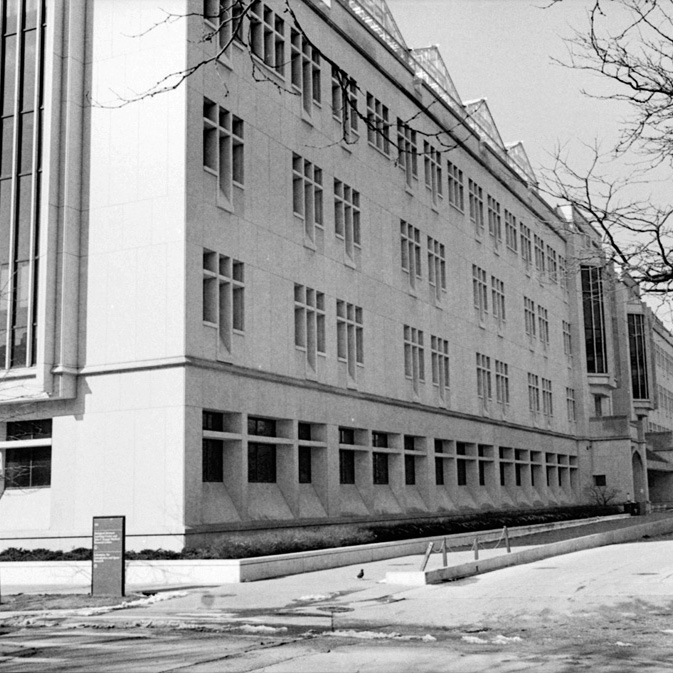
A $12 million gift from the Pritzker family in 1968 led to the medical school’s formal naming as the Pritzker School of Medicine. In 1993, the Biological Sciences Learning Center opened as a dedicated home for medical students, bringing research, teaching, classrooms, and laboratories together in one place. The building was renamed Donnelly Hall in 1998 in recognition of a generous gift from the Gaylord and Dorothy Donnelly Foundation.

The space is still home to the Pritzker School of Medicine and provides facilities for MD/PhD students in the Medical Scientist Training Program.